
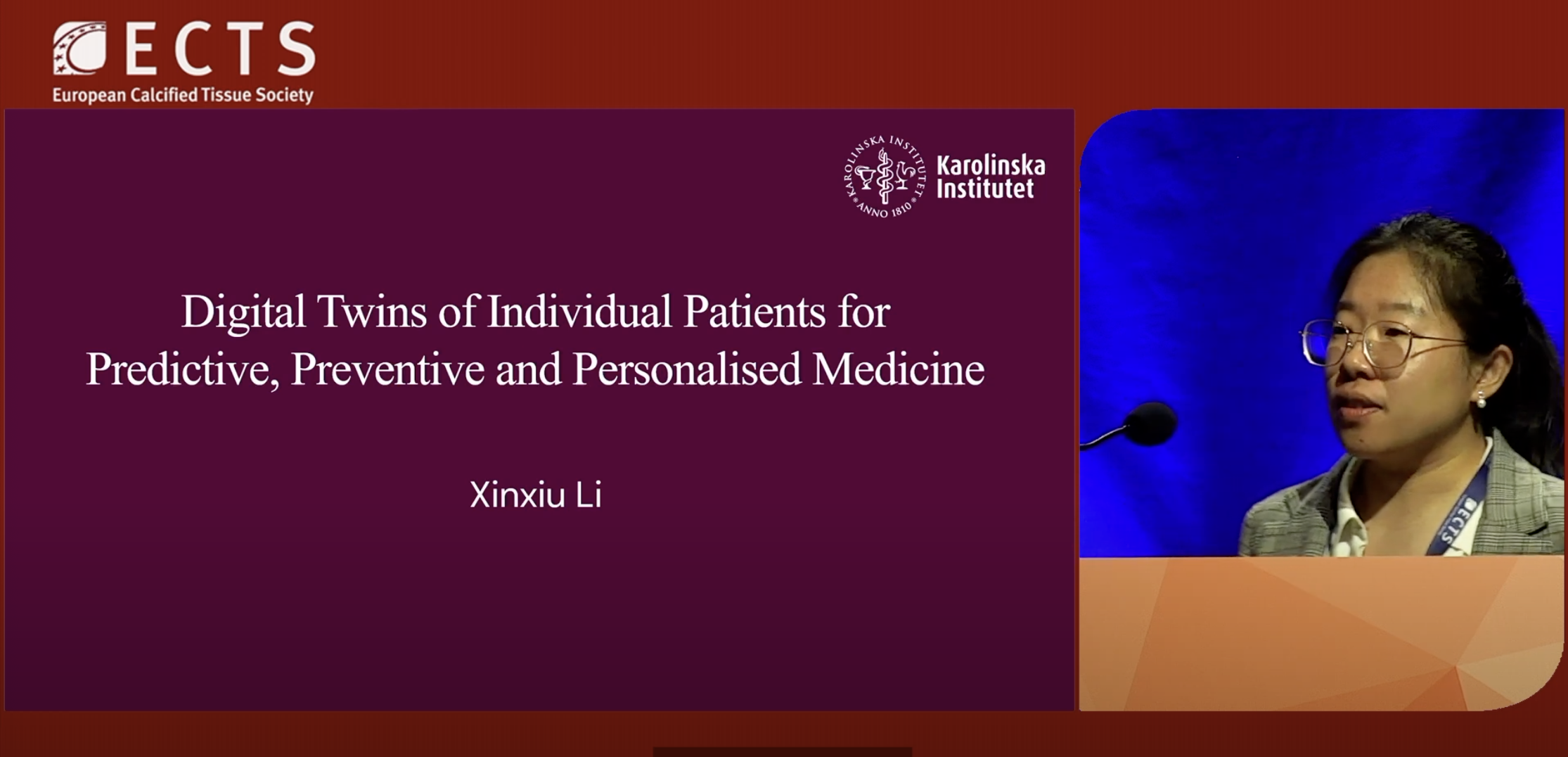
Recording of the 2025 ECTS–IFMRS Joint Session, Vienna
Speaker: Dr Xinxiu Li (Karolinska Institutet, Stockholm, Sweden)
Patient-specific digital twins = thousands of variables cloned
A high-performance model integrates omics, clinical, and lifestyle data to create unlimited copies of one patient, each exposed in silico to a different drug. Comparing responses pinpoints the treatment most likely to work in real life.
Why they matter: Medication failure is often a timing problem
Late diagnosis, lack of early biomarkers, and years of silent disease progression drive poor efficacy and huge costs. Digital twins shift the focus upstream—predicting risk, preventing onset, and tailoring therapy before irreversible damage occurs.
Data resolution is everything
Bulk data are like mixed Lego bricks; single-cell and spatial omics sort them by colour and position, revealing which cell types spark disease and where they sit in tissue. That granularity enables precise biomarker discovery and cell-targeted drug search.
Arthritis as a proving ground
Chosen for its joint-plus-immune features, rich single-cell datasets, and tractable mouse models. Analysis of 45 human cell types flagged 24 strongly linked to arthritis and thousands of risk genes.
Multi-organ, multi-cell networks expose hidden crosstalk
A mouse single-cell atlas uncovered ~1,000 inter-organ interactions—joints, lung, muscle, skin, and even brain – explaining extra-articular symptoms invisible in routine exams.
Module-based strategy finds actionable targets
Disease-related protein clusters (modules) reveal convergent pathways, early biomarkers, and druggable nodes – even amid noisy data. The method extends to DNA, RNA, symptoms, and lifestyle layers for richer predictions.
Drug-ranking engine validates fast
Mapping modules onto DrugBank and scoring intra/inter-cellular centrality produced a top-five list; two candidates (dabrafenib, amurannon) suppressed B-cell activation in vitro and eased joint inflammation in mice.
Personalisation demo: TNF-α responders vs non-responders
Patient-specific network models showed TNF-α as a central hub only in responders; the drug-ranking list differed completely between the two, illustrating how twins can prioritise therapy on a person-by-person basis.
Early-warning markers without big panels
‘Upstream regulator‘ mining distils hundreds of genes to a handful that control disease trajectories, while a spatiotemporal ML method (StudioTime) pinpoints progression genes that achieved high AUC in > 2,000 clinical samples—enabling routine-test detection.
Take-home message
Network-driven digital twins can predict, prevent, and personalise treatment by linking multi-layer data to drug and biomarker discovery, and the approach is directly transferable to other complex diseases.