Sarcopenia/Osteosarcopenia Symptoms and Risk Factors

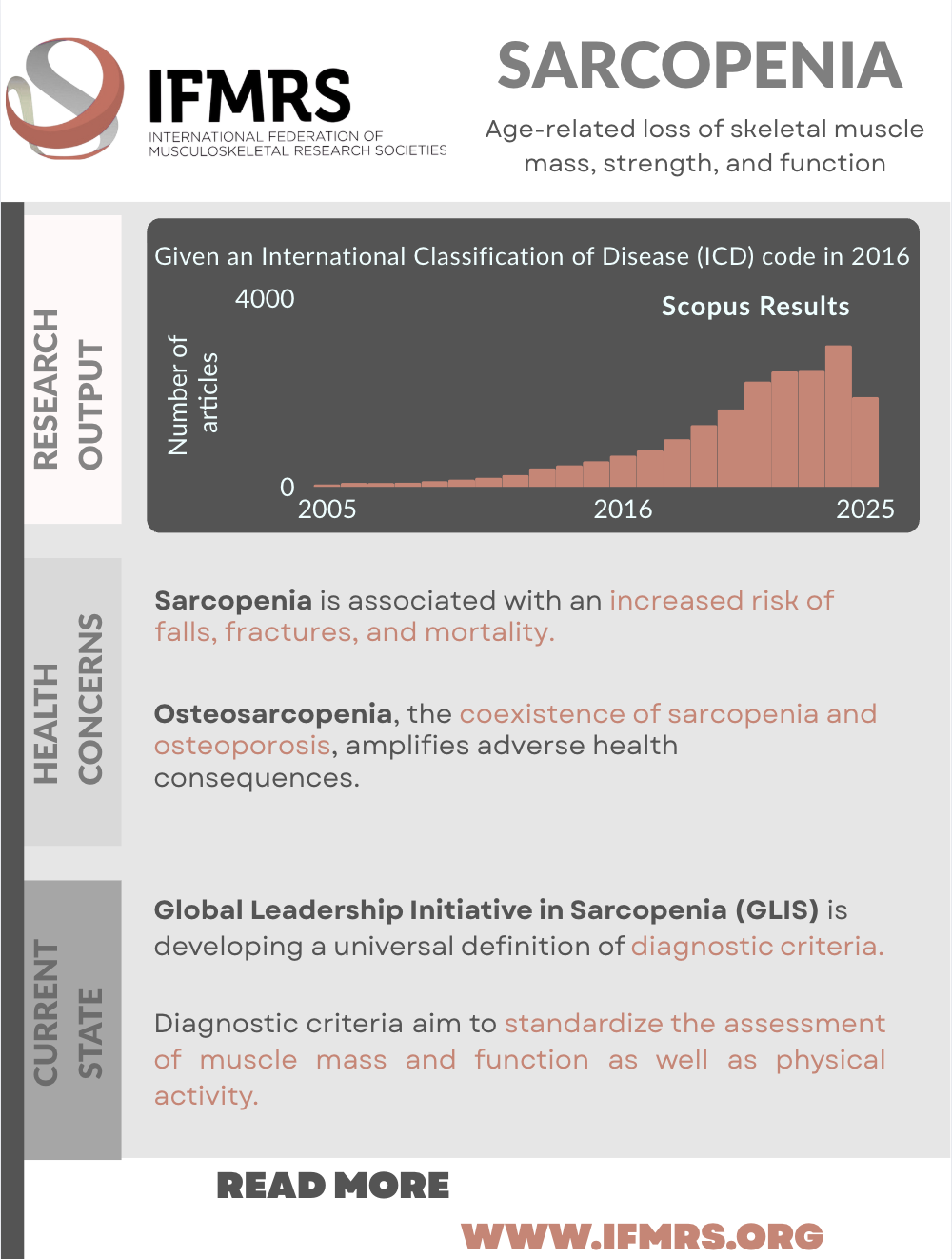
SARCOPENIA AND OSTEOSARCOPENIA INFOGRAPHIC

  • ~3,500 Scopus papers projected for 2025 since sarcopenia received the ICD-10-CM code M62.84 (2016).

  • Higher risks of falls, fractures, mortality; risk escalates further in osteosarcopenia (sarcopenia + osteoporosis).

  • The Global Leadership Initiative in Sarcopenia (GLIS) is finalising universal diagnostic criteria to harmonise case finding and trial endpoints.

  • Standardised cut-points for muscle mass, strength, function, and physical activity are central to the coming guidelines.

Recommended reading and data sources

Other definitions based on regions:

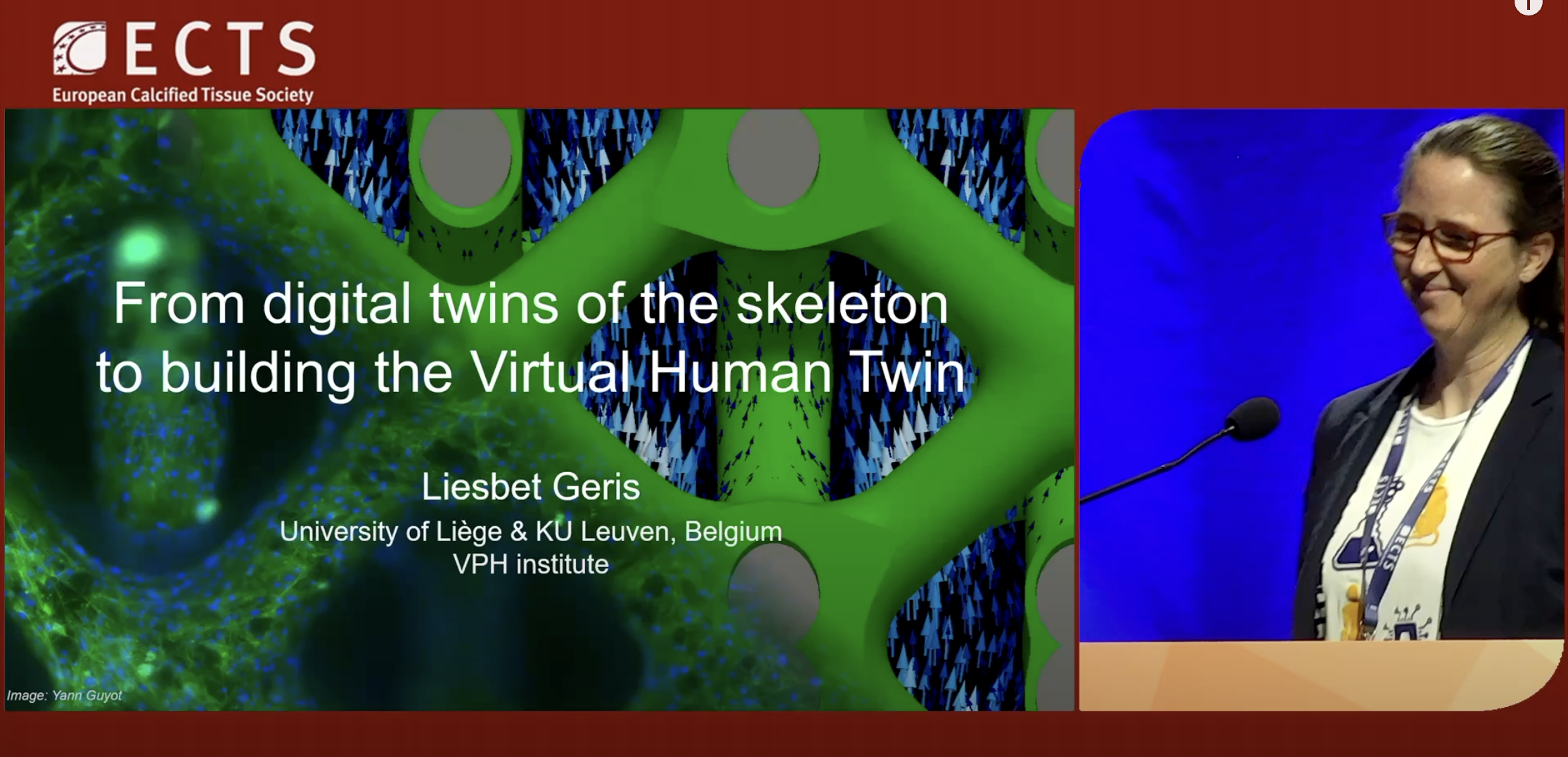
Building the Virtual Human Twin: Latest in Skeletal Digital Twins

Recording of the 2025 ECTS–IFMRS Joint Session, Vienna
Speaker: Prof. Liesbet Geris (University of Liège & KU Leuven, Belgium)
Digital twins are no longer just an engineering curiosity; they are becoming a cornerstone of personalized medicine. In this keynote, delivered at the 2025 ECTS–IFMRS meeting in Vienna, Prof. Liesbet Geris demonstrates how patient-specific models are already guiding implant design and surgical planning, and then looks ahead to Europe’s ambitious ‘Virtual Human Twin’ platform, which will connect multiscale models, data, and standards across the continent.
 
Key Insights: 

Data and model always go together

Digital twins rely on four layers working in concert:

sensors/measurements → middleware → computing hardware → software models.

Twins can represent cells, tissues, organs, whole systems, medical devices, bioprocesses or entire facilities, whichever is sufficient to answer the clinical or research question.

Modelling spans a spectrum, not just AI

From black-box, data-only approaches to white-box, physics-only ones, most useful twins sit in the grey zone – hybrid models that combine mechanistic knowledge with machine-learning components to curb ‘hallucinations’.

Lab examples show the breadth of scales

  • Single-cell cartilage atlas & executable GRN model – maps chondrogenic differentiation states, then predicts interventions to steer cells; predictions validated in vitro.
  • Multiscale osteoarthritis twin – links gait-derived joint loading → cartilage stress → integrin signalling → intracellular response.
  • Curvature-driven scaffold growth model – converts the biological rule ‘cells fill concave corners first’ into maths; guided design of gyroid bone implants that outperformed lattices in mouse and large-animal studies.
  • Agent-based fracture-healing model – simulates macrophage M0 → M1 → M2 dynamics and cytokine fields during the inflammatory phase; calibrated with in-vivo immunofluorescence, now being extended with mechanical loading data.

Clinical traction is already real (at single-organ scale)
Personalized left-atrial appendage occluder sizing, surgical planning tools, and other device-focused twins are in routine use and even reimbursed; one physics-only twin has entirely replaced a medical-device clinical trial.

Regulatory and credibility science are maturing
EMA/FDA guidance, emerging “Good Simulation Practice” and ~150 existing standards give clear (if complex) pathways for validation, documentation, and risk management.

Europe’s next step: the Virtual Human Twin initiative
The EU aims to knit dispersed efforts into a shared platform that includes:

  • catalogue of models, data sets, and workflows;
  • tooling for automated credibility tests;
  • common metadata so models can ‘crawl’ data spaces;
  • alignment with the European Health Data Space, AI Act, MDR, etc.

Community-built roadmap & manifesto
800+ stakeholders co-authored a 30-recommendation roadmap (plus a short policy brief and 2-page manifesto) emphasising unmet-need-driven use cases, full clinical-workflow integration, and sustainable infrastructure and business models.

Validation remains context-dependent
High-TRL scaffold work moves quickly from mouse to large-animal to spin-off products; the inflammatory fracture-healing twin is lower-TRL and still in fundamental calibration, illustrating that digital first, then bench & animal is iterative, not linear.

Bottom line
Digital twins are already delivering niche clinical value, and hybrid, multiscale approaches are unlocking far richer questions – from single-cell fate decisions to hospital logistics. Europe’s Virtual Human Twin push seeks to make those scattered successes reproducible, interoperable, and trustworthy at continent scale.

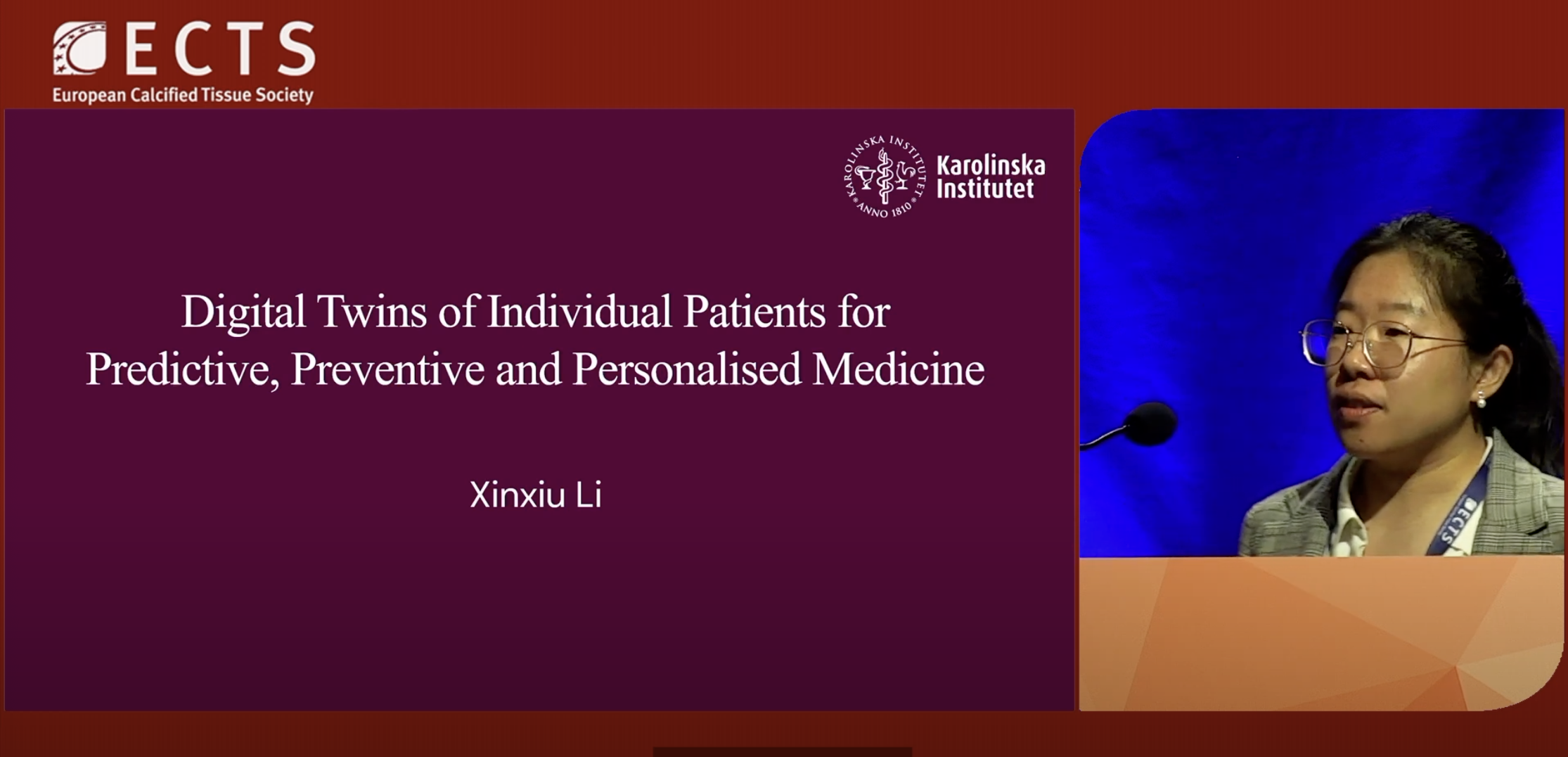
Digital Twins Power Early Diagnosis & Targeted Therapy

Recording of the 2025 ECTS–IFMRS Joint Session, Vienna
Speaker: Dr Xinxiu Li (Karolinska Institutet, Stockholm, Sweden)
Digital-twin technology can do more than replicate organs; it can clone entire patients in silico. In this talk, Dr Lin Xinxiu shows how multi-omic, single-cell, and spatial data feed high-resolution “copies” of arthritis sufferers, letting researchers trial thousands of drugs virtually, uncover early biomarkers, and prioritise personalised therapies long before symptoms appear.
 
Key Insights: 

Patient-specific digital twins = thousands of variables cloned
A high-performance model integrates omics, clinical, and lifestyle data to create unlimited copies of one patient, each exposed in silico to a different drug. Comparing responses pinpoints the treatment most likely to work in real life.

Why they matter: Medication failure is often a timing problem
Late diagnosis, lack of early biomarkers, and years of silent disease progression drive poor efficacy and huge costs. Digital twins shift the focus upstream—predicting risk, preventing onset, and tailoring therapy before irreversible damage occurs.

Data resolution is everything
Bulk data are like mixed Lego bricks; single-cell and spatial omics sort them by colour and position, revealing which cell types spark disease and where they sit in tissue. That granularity enables precise biomarker discovery and cell-targeted drug search.

Arthritis as a proving ground
Chosen for its joint-plus-immune features, rich single-cell datasets, and tractable mouse models. Analysis of 45 human cell types flagged 24 strongly linked to arthritis and thousands of risk genes.

Multi-organ, multi-cell networks expose hidden crosstalk
A mouse single-cell atlas uncovered ~1,000 inter-organ interactions—joints, lung, muscle, skin, and even brain – explaining extra-articular symptoms invisible in routine exams.

Module-based strategy finds actionable targets
Disease-related protein clusters (modules) reveal convergent pathways, early biomarkers, and druggable nodes – even amid noisy data. The method extends to DNA, RNA, symptoms, and lifestyle layers for richer predictions.

Drug-ranking engine validates fast
Mapping modules onto DrugBank and scoring intra/inter-cellular centrality produced a top-five list; two candidates (dabrafenib, amurannon) suppressed B-cell activation in vitro and eased joint inflammation in mice.

Personalisation demo: TNF-α responders vs non-responders
Patient-specific network models showed TNF-α as a central hub only in responders; the drug-ranking list differed completely between the two, illustrating how twins can prioritise therapy on a person-by-person basis.

Early-warning markers without big panels
Upstream regulator‘ mining distils hundreds of genes to a handful that control disease trajectories, while a spatiotemporal ML method (StudioTime) pinpoints progression genes that achieved high AUC in > 2,000 clinical samples—enabling routine-test detection.

Take-home message
Network-driven digital twins can predict, prevent, and personalise treatment by linking multi-layer data to drug and biomarker discovery, and the approach is directly transferable to other complex diseases.