
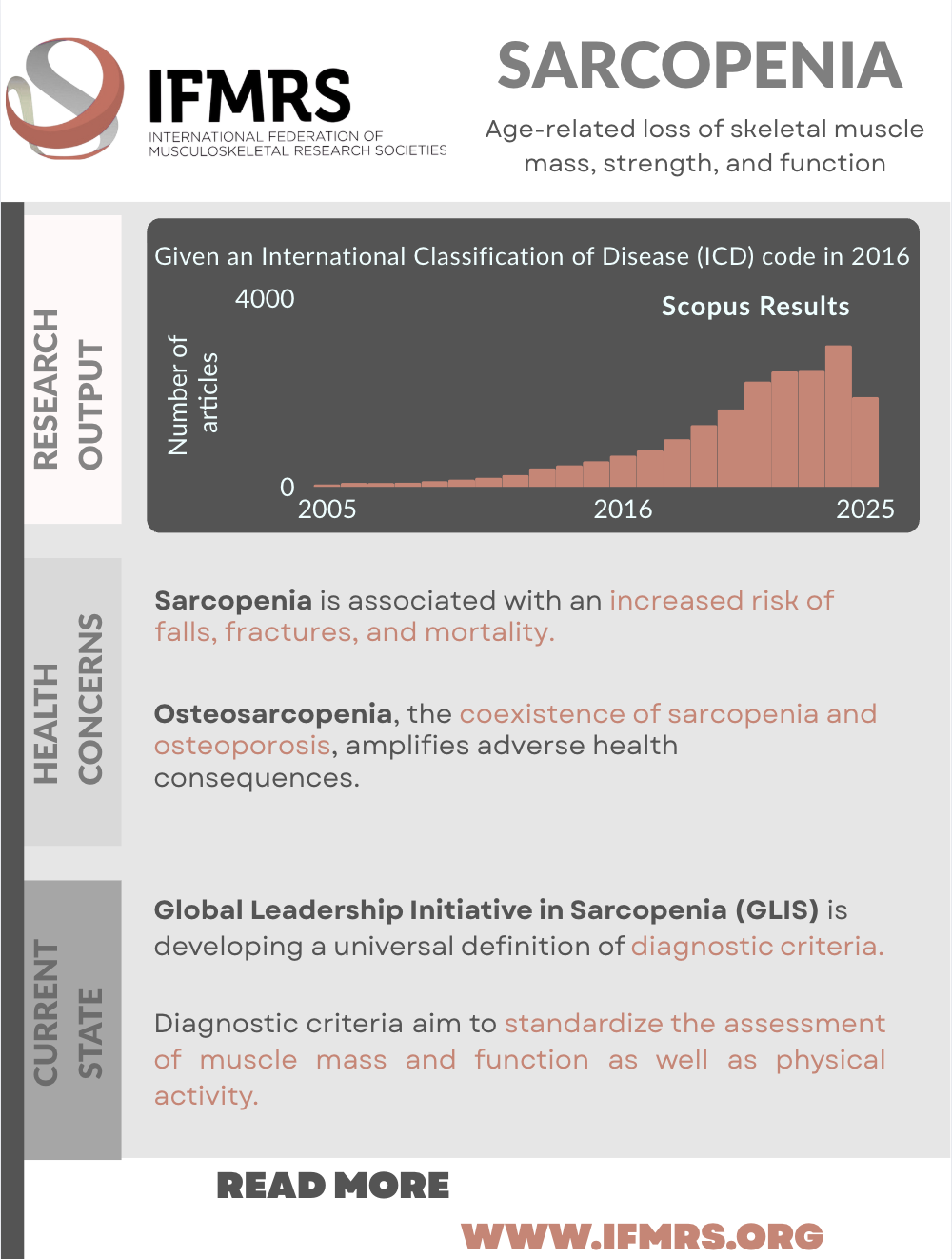
SARCOPENIA AND OSTEOSARCOPENIA INFOGRAPHIC
~3,500 Scopus papers projected for 2025 since sarcopenia received the ICD-10-CM code M62.84 (2016).
Higher risks of falls, fractures, mortality; risk escalates further in osteosarcopenia (sarcopenia + osteoporosis).
The Global Leadership Initiative in Sarcopenia (GLIS) is finalising universal diagnostic criteria to harmonise case finding and trial endpoints.
Standardised cut-points for muscle mass, strength, function, and physical activity are central to the coming guidelines.
Recommended reading and data sources
- Definition of sarcopenia (GLIS)
https://pmc.ncbi.nlm.nih.gov/articles/PMC10960072/ - Health outcomes (GLIS)
https://pubmed.ncbi.nlm.nih.gov/40120052/ - Osteosarcopenia
https://onlinelibrary.wiley.com/doi/10.1002/jcsm.12567,
ECTS presentation by Gustavo Duque
Other definitions based on regions:
- International (both from 2010)
https://www.jamda.com/article/S1525-8610(11)00019-3/fulltext,
https://www.jamda.com/article/S1525-8610(11)00142-3/fulltext - Asian Working Group (2020):
https://www.sciencedirect.com/science/article/pii/S1525861019308722 - Australia and New Zealand (2022)
https://pmc.ncbi.nlm.nih.gov/articles/PMC9891980/ - Europe (2019)
https://pubmed.ncbi.nlm.nih.gov/30312372/